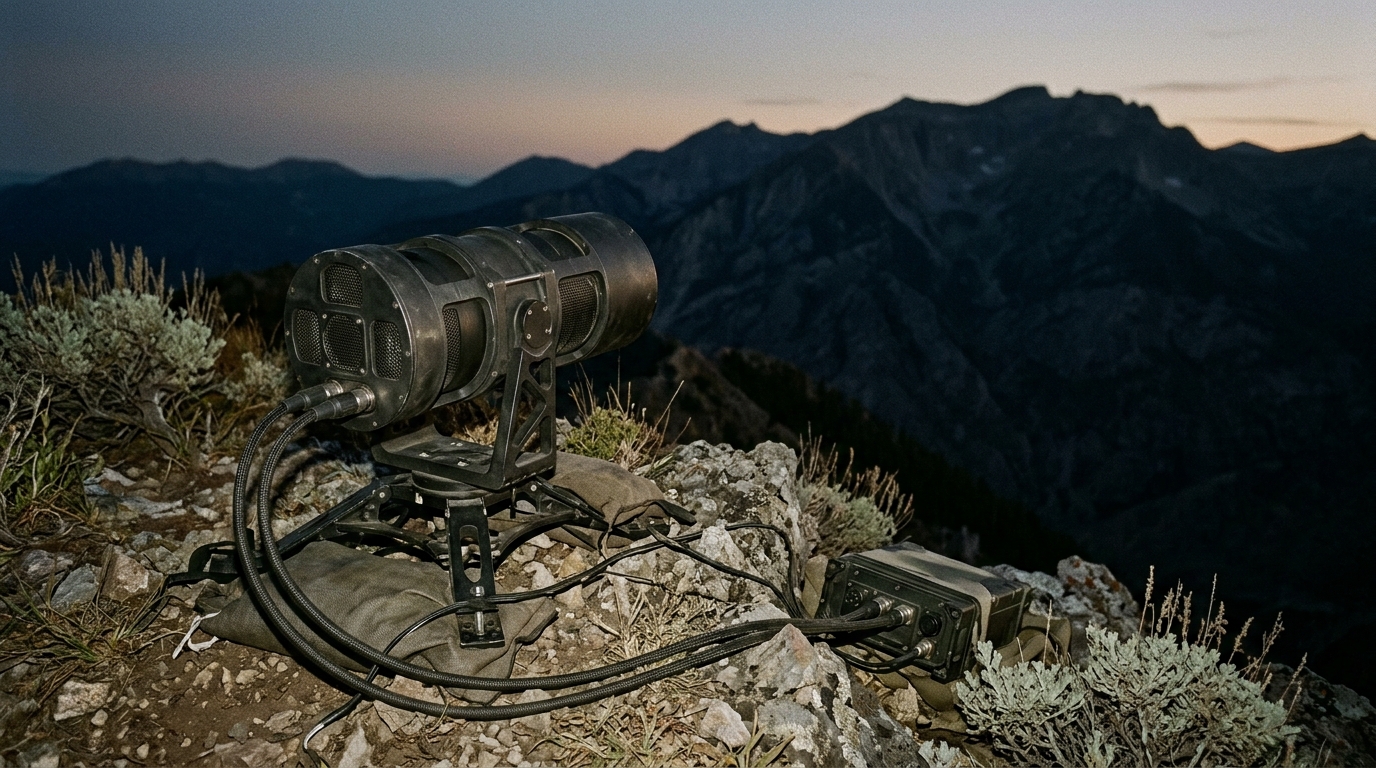
01The blind spot radar and RF leave open
Most counter-UAS stacks were built around two sensing families: radar, which is excellent at range but struggles against small, slow, low radar-cross-section targets flying close to clutter; and RF direction-finding, which is excellent against drones actively transmitting a control or video link, but blind to anything flying pre-programmed, autonomous, or over a jammed or silent link.
Between them, a specific class of threat slips through: small, slow, quiet, RF-silent drones at short-to-medium range. That is precisely the profile of commercial and improvised drones deployed in border-security and contested battlefield contexts today.
02What passive acoustic detection actually measures
Every propeller and motor produces a distinct broadband and tonal acoustic signature as it moves through air. An acoustic sensor node (typically an array of calibrated MEMS microphones) continuously samples ambient sound and executes localized classifiers to isolate drone signatures from wind, traffic, and background noise.
Because sound arrives at each microphone in the array at a slightly different time, the array can triangulate bearing from a single node, and full 3D position, altitude and track when multiple nodes are networked together.
Critically, this is a passive sensor: it emits nothing. There is no transmitted signal for an enemy RF-warning receiver to detect, and no waveform for a jammer to attack. The only way to defeat an acoustic sensor is to make the drone physically quieter, which forces severe trade-offs in payload capacity and flight speed.
03Operational deployment at scale in active combat zones
Acoustic counter-UAS has moved well past the demonstrator stage. High-intensity combat operations have demonstrated that mass-deployed acoustic sensor networks, numbering in the thousands of distributed nodes, feed early-warning systems at a fraction of the cost of a single radar installation.
Frontline border security doctrines have followed suit, deploying acoustic detection along extensive territorial boundaries. Ground forces now actively procure tactical acoustic nodes that classify and localize small drones, transmitting bearings directly to tactical edge terminals without requiring dedicated consoles.
The operational consensus across these deployments is clear: acoustic sensing does not replace radar or RF. Instead, it fills the exact blind spots they leave, at a sensor cost low enough to deploy in depth across vast perimeter zones.
04Where acoustic fits in a layered stack
In a mature counter-UAS architecture, acoustic detection sits at the front of the engagement chain for cueing. Bearing and range from an acoustic node rapidly slew electro-optical sensors onto the designated sector, enabling continuous visual tracking, firing solutions, and human-authorized countermeasures.
Acoustic sensing does not need to execute the kinetic engagement itself. It reliably informs the rest of the stack where to look, especially when electronic countermeasures blind RF and radar sensors.
05Where it still struggles
Acoustic detection is not a standalone silver bullet. Resolving simultaneous acoustic sources during swarm incursions requires multi-node triangulation. Extreme ambient acoustic noise can attenuate effective range. Consequently, sovereign doctrine pairs acoustic arrays with electro-optical tracking to form a resilient, layered sensor matrix.
Frequently Asked Questions
Can passive acoustic drone detection be jammed?
No. Acoustic detection listens for physical motor and propeller acoustics. Because it does not rely on radio emissions, it cannot be jammed or spoofed by electronic countermeasures.
How does passive acoustic detection work?
An array of microphones (often MEMS-based) captures ambient sound continuously. Software separates propeller and motor signatures from background noise, then uses the tiny arrival-time differences between microphones to estimate bearing, and in networked arrays, position, altitude and approximate classification.
Is acoustic detection a replacement for radar and RF sensors?
No, it is a complementary layer. Acoustic sensors excel at short-to-medium range in electronically contested environments, cueing long-range radar and optical turrets in a layered counter-drone stack.
What are the limitations of acoustic drone detection?
Acoustic sensors struggle to cleanly separate multiple simultaneous threats, which makes swarm scenarios harder, and performance can degrade in high ambient-noise environments (traffic, wind, crowds). Networking multiple sensor nodes and fusing with other sensor types mitigates both.